Are Toll-Free Numbers Free From a Cell Phone?
Quick Answer
Toll-free numbers are free from a landline, but a cell phone is different. The FCC says calls to toll-free numbers are free from landlines, while wireless callers use airtime minutes unless their plan is unlimited. So the call carries no toll charge, but it can still count against the minutes in your plan.
On this page
Key Takeaways
- "Toll-free" means the person calling does not pay a per-call toll. The business or agency that owns the number pays instead.
- From a landline the call is free. From a cell phone it uses airtime minutes unless your plan is unlimited.
- Seven codes are toll-free: 800, 888, 877, 866, 855, 844 and 833. They are not interchangeable.
- A toll-free number does not point to a place, and caller ID can show any number, so the number on your screen proves little.
Are toll-free numbers really free from a cell phone?
Mostly yes, with one catch. A toll-free number is one that you can call without a long-distance or per-call toll charge. The word "free" describes the toll, not the airtime your phone uses to make the call.
On a landline, the FCC says calls to toll-free numbers are free. On a cell phone, the FCC says the call uses airtime minutes from your plan unless the plan is unlimited [1]. Airtime means the minutes of calling time your plan counts, the same way it counts a call to a friend.
Here is what that means in everyday terms:
- If your plan has unlimited calling, a toll-free call costs you nothing extra.
- If your plan counts minutes, a toll-free call uses some of them, just like any other call.
- The business still pays the toll. That is a separate arrangement between the business and the network, not part of your airtime.
Many plans today include unlimited calling, so most people will never notice. The detail matters most for prepaid phones or older plans with a monthly minute limit. If you are not sure which kind of plan you have, your carrier can tell you. The terms are in your plan paperwork or your online account.
Who pays for a toll-free call?
The business pays. When a company or agency sets up a toll-free number, it agrees to cover the cost of the calls that come in, so callers do not have to. That is why the name says "toll-free" and not "cost-free."
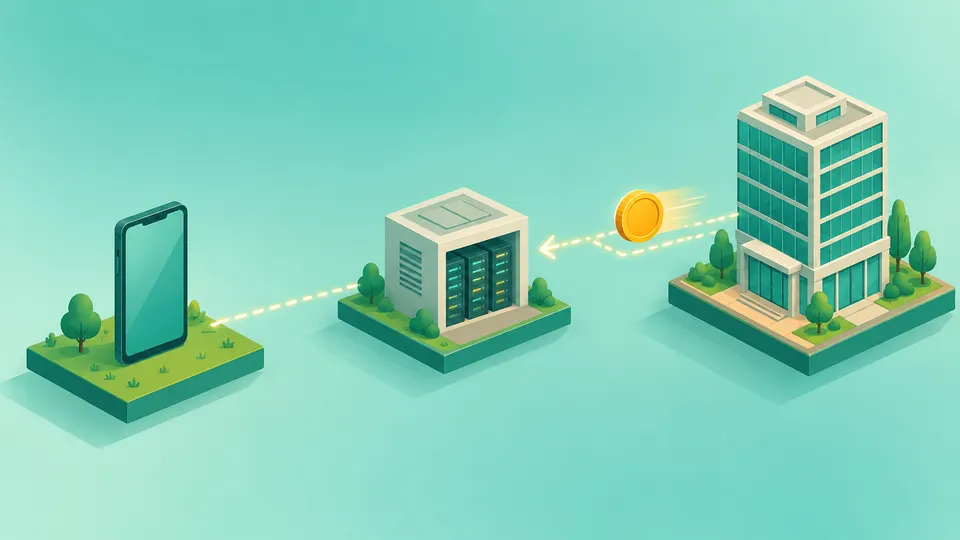
The picture below shows the idea. Your call travels from your phone, through the phone network, to the business. Your cell phone counts the minutes. The business sends payment back to the network for carrying the call.
Behind the scenes, each toll-free number is connected to a regular number that the business actually uses. The FCC explains that a toll-free number routes to a local number, so the call lands at the business's real line [1]. The toll-free number is a front door, and the regular number is the room behind it.
You do not need to do anything for this to work. You dial the toll-free number, and the network handles the rest. If you want to check how a number is written before you dial, the Number Format Check shows whether it is a standard ten-digit number.
Which area codes are toll-free?
Seven codes are toll-free: 800, 888, 877, 866, 855, 844 and 833. The FCC lists the same seven [1]. They look like area codes, and people often call them that, but they work differently. A regular area code points to a part of the country. A toll-free code does not.
The 800 code came first. Our records, which follow the North American Numbering Plan list, show it in use since 1966 [4]. As businesses ran short of 800 numbers, more codes were added. The 888 code followed in 1996, then 877 in 1998, 866 in 2000, 855 in 2010, 844 in 2013 and 833 in 2017.
You can read more about each code on our toll-free area codes page, or open a single code such as 800, 888 or 833.
Are the toll-free codes interchangeable?
No. The FCC points out that the codes are not interchangeable [1]. The same seven digits after 800 and after 888 can reach two different businesses. For example, (800) 555-0100 and (888) 555-0100 are two separate numbers, even though the last seven digits match. If you misdial the code, you may reach a stranger, or nobody at all.
When you copy a toll-free number from a letter, a bill or a website, check the first three digits as carefully as the rest.
Does a toll-free number tell you where a business is?
No. A regular area code shows the area where a number was first assigned. A toll-free code is different, because any business in the North American Numbering Plan can use one. A company in Maine can have an 855 number, and so can a company in Oregon. Our toll-free codes page says the same: these codes do not identify a location.
That is why a toll-free code cannot be matched to a city. If you want to see what a regular three-digit code tells you, try the Area Code Lookup.
There is a second reason not to read too much into a number on your screen. The FCC explains that caller ID can be made to show any number, which is called spoofing [2]. A call that appears to come from a toll-free number may not come from the business that owns it. The reverse is also true, and a real toll-free call can look odd. The number alone tells you very little either way.
So we avoid guessing. A toll-free code is not a warning sign, and it is not a seal of approval. If a call matters and you are unsure about it, hang up and call the organization back using a number printed on your bill, your card or the company's official website. Our guide on how to find out where a call came from explains what a number can and cannot show. If you also want to learn why some local numbers need ten digits, see what an area code overlay is.
How can you avoid surprise charges on a cell phone?
The risk is small, and a few quick checks keep it that way. Start with the comparison below, which sums up what the FCC says about landlines and cell phones.
Then try these steps:
- Find out whether your plan is unlimited. Check your plan details or ask your carrier. If calling is unlimited, there is nothing more to think about.
- Know your minute limit if you have one. On a plan that counts minutes, a long toll-free call, such as a wait on hold, uses the same minutes as any other call.
- Check the number before you dial. Make sure the toll-free code is the one the business printed. A wrong code is a different number.
- Use an official source for the number. Take it from the company's own website, your bill or your card, not from a message you did not expect.
If your bill shows a charge you do not recognize, contact your carrier first. If the carrier cannot sort it out, the FCC has a Consumer Complaint Center where you can file a complaint [3].
Frequently Asked Questions
Do toll-free calls use minutes on a cell phone?
They can. The FCC says wireless callers use airtime minutes when they call a toll-free number, unless they have an unlimited plan. The toll itself is paid by the business.
Are 800, 888, 877, 866, 855, 844 and 833 all the same?
They are all toll-free, but they are not interchangeable. The same seven digits after two different toll-free codes can belong to two different businesses, so always dial the full number as given.
Is a toll-free number a scam?
No. A toll-free code says nothing about whether a call is trustworthy. Because caller ID can be spoofed, the number on your screen can also be wrong. If you doubt a call, end it and call back through a number from an official source.
Does a toll-free number show where the caller is?
No. Toll-free codes are not tied to a place, and any business in the North American Numbering Plan can use one. The call is routed to a regular number that the business chooses.
Our Take
We think the plain answer is the most useful one: toll-free means you do not pay a toll, not that nothing ever counts against you. For most people with unlimited calling, the difference never shows up. For anyone on a plan with a minute limit, it is worth knowing. We also think readers should be careful not to attach meaning to a toll-free code. It does not tell you where a company is, and it does not tell you whether a call is genuine. Use the number printed on your bill or on a company's official site, and treat the screen as a hint, not proof.
Sources
- What Is a Toll-Free Number and How Does it Work?. FCC, 2019.
- Caller ID Spoofing. FCC, 2024.
- FCC Consumer Complaint Center. FCC.
- List of North American Numbering Plan area codes. Wikipedia (CC BY-SA 4.0).
An area code shows where a number was first assigned, not where the caller is or who they are. Numbers move with people and caller ID can be spoofed. Spotted an error? Tell us.