How to Find Out Where a Call Came From (and What an Area Code Can't Tell You)
Quick Answer
You usually cannot learn where a call really came from by looking at the number. An area code shows where a number was first assigned, not where the caller is today or who they are, and caller ID can be faked. The safer path is to check the code with our lookup, share nothing, hang up if the call feels wrong, and reach a business only through an official number.
On this page
- What can you actually learn from a phone number?
- What does an area code tell you, and what can't it tell you?
- Why can't an area code show where someone is now?
- Why can caller ID be wrong?
- What can you do when a call looks strange?
- Why doesn't AreaCode Wise look up who called?
- Frequently Asked Questions
- Our Take
- Sources
Key Takeaways
- An area code points to the place a number was first set up. It does not show where the caller is now.
- Phone numbers travel with people, and toll-free codes such as 800 or 888 are not tied to any place.
- Scammers can make any name or number show on caller ID, so a "local" number proves nothing.
- The calm move is to skip unknown calls, never share codes or payment details, and call back only through a number you trust.
- You can report unwanted or suspicious calls to the FTC and the FCC.
What can you actually learn from a phone number?
When an unfamiliar number rings your phone, it is natural to want to know where it came from. The honest answer is that the number alone tells you less than you might hope. The first three digits, called the area code, show you one thing with confidence: the area the number was originally set up in.
For example, if a number starts with 212, it was first assigned in Manhattan. Our page for area code 212 says it serves Manhattan in New York, uses Eastern Time, and has been in service since 1947. That is useful background. It is not a statement about the person holding the phone right now.
You can look up any code on our Smart Number Lookup. It shows the home area, the time zone, and whether the code is an overlay (a second code added to the same area). Every page carries the same plain reminder: an area code does not reveal the caller's current location or identity, because numbers can travel with people, and calls can be forwarded or spoofed.
What does an area code tell you, and what can't it tell you?
Think of an area code as a return address printed years ago. It tells you where the envelope started its life. It does not tell you where the sender lives today, or whether the sender is who they claim to be.
There is a second thing a code can tell you. Some codes are toll-free (800, 888, 877, 866, 855, 844 and 833). The FCC explains how toll-free numbers work [5], and our toll-free codes page lists them. A toll-free code is not a place at all, so it cannot say where a call started. If you are wondering about cost, see are toll-free numbers free from a cell phone.
Why can't an area code show where someone is now?
Because phone numbers follow people, not buildings. Three everyday situations show why.
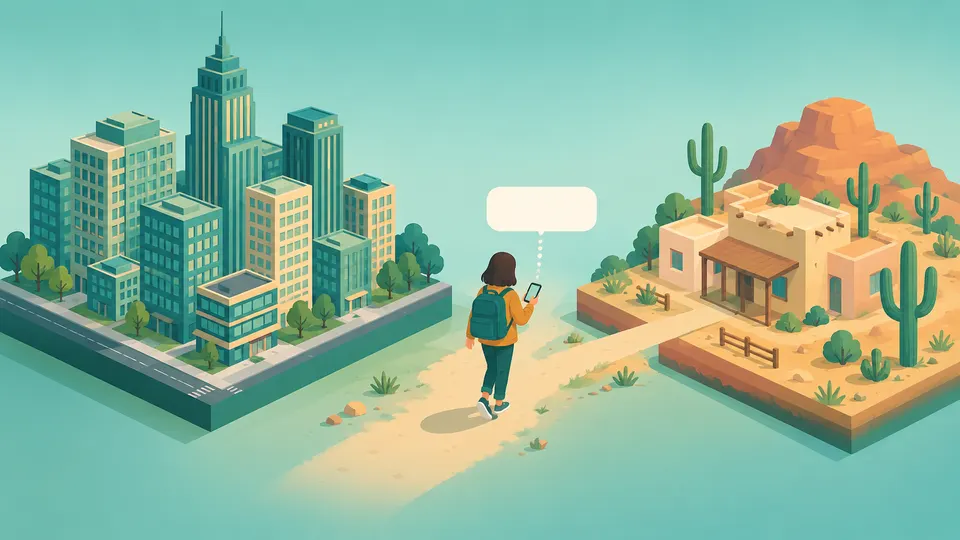
People move and keep their numbers. Many people keep the mobile number they had when they moved to a new state. A phone with a 212 number can sit in a pocket in Houston, and nothing about the number changes.
Numbers can be forwarded or routed. A call can be passed along to another phone or through an online phone service, so the number that appears is not always the phone that rings on the other end.
Some codes cover a whole country's worth of callers. Toll-free numbers, as noted above, have no home place.
The scene below shows the first case. The number tag stays the same while the person carries it to a new home.
If that Texas resident calls you, the screen shows 212, and you might guess they are in New York. You would be wrong. This is why we never describe an area code as "where the caller is." If you want to see how much of Texas has its own codes, our pages for area code 214 (Dallas area) and area code 832 (Houston area) show where those numbers began.
This is also why you should be careful about guessing from a number. Two people who both show a 214 number may live in different states, and one caller with a 212 number may be a neighbor who simply kept an old phone number. The code is a clue about history. It is never a verdict about the person calling you today.
Why can caller ID be wrong?
Even the number on your screen may not be real. The FCC explains that scammers use "neighbor spoofing," which means making a call look like it comes from a local number, or even from a company or agency you know [1]. The FTC adds that scammers can make any name or number show up on your caller ID [2].
That has a simple consequence: a call that shows your own area code, or a name you trust, is not proof of anything. A "local" number can be a disguise. So the question to ask is not "where is this call from?" but "do I have any reason to trust it?"
The same advice applies to requests for numeric codes. The FTC has a consumer alert on verification codes, explaining what they are and why someone who contacts you out of the blue may ask for one [3]. If a stranger asks you to read out a code, do not.
What can you do when a call looks strange?
You cannot reliably trace a call yourself, but you can protect yourself. Here is a short, calm routine.
Check the area code, then set it aside
Typing the code into our Smart Number Lookup gives you the home area and time zone, which can help with simple questions such as "is this a good hour to call back a number I know?" It will not tell you whether the caller is honest. If you are unsure whether to return a missed call at all, try Should I Call Back?, which walks you through the questions to ask.
Do not share information or call back strange numbers
The FCC advises not answering calls from unknown numbers, and the FTC lists warning signs of phone scams on its Phone Scams page [2] [2]. If a caller claims to be your bank or a government agency, the FCC says to hang up and call the number on your statement or the organization's official website [1]. A real organization will not mind.
A call that rings once and stops is its own situation, and we cover it in how to handle a one-ring call.
Ask your carrier about call tools
Mobile carriers often offer call-blocking or call-labeling features, and the options differ by company and plan. We cannot tell you which ones suit your phone, so the simplest step is to ask your carrier what it offers.
Report what you receive
The FTC says that if you lost no money, you can report unwanted calls at DoNotCall.gov, and if you lost money, you can report at ReportFraud.ftc.gov [7] [4]. You can also file a complaint with the FCC Consumer Complaint Center [6] (retrieved 2026-11-19). If someone threatens you or you feel unsafe, contact your local police.
Why doesn't AreaCode Wise look up who called?
Some sites offer to name the person behind a number. We deliberately do not. Our methodology is built on public numbering data, which describes areas, not people. You can read how we handle our data on the methodology page.
There are three reasons. First, the data would not be reliable: given that numbers move and can be faked, any name attached to a number could be wrong, and a wrong name can point a person at the wrong person. Second, it would invite the kind of guessing that causes harm, such as confronting a stranger. Third, it would not make you safer. The steps in the chart above work whether or not you know who is on the other end.
So when we say "check the area code," we mean learn something about where the number began, and nothing more.
Frequently Asked Questions
Does an area code tell me where the caller lives?
No. It shows where the number was first assigned. People often keep their number when they move, and calls can be forwarded or spoofed, so the caller may be far from the code's home area.
Why does a call show my own area code?
Scammers can make a call look local on purpose, which the FCC calls neighbor spoofing. A matching area code is not evidence that the caller is nearby or that the call is genuine.
Can toll-free numbers show where a call came from?
No. Codes such as 800 and 888 are not tied to a place. The business behind the number could be anywhere. See our toll-free guide for how they work.
Where do I report a suspicious call?
Use ReportFraud.ftc.gov if you lost money, DoNotCall.gov if you did not, and the FCC Consumer Complaint Center for call complaints. Contact local police if you are threatened.
Our Take
We think the most useful thing a phone number site can say is what a number cannot do. It is tempting to treat an area code as a clue to a caller's whereabouts, and that is how people end up trusting a "local" scam call or distrusting a real one. We would rather give you a fact you can rely on, where the number began, and then point you to steps that work no matter who is calling: share nothing, hang up when unsure, and use a number you found yourself. That is also why we do not offer name lookups. Our job is to explain numbers clearly, not to guess about people. This is our opinion, and it follows the FCC and FTC advice cited here.
Sources
- Caller ID Spoofing. FCC, 2024.
- Phone Scams. FTC, 2023.
- What's a verification code and why would someone ask me for it?. FTC, 2024.
- National Do Not Call Registry FAQs. FTC, 2023.
- What Is a Toll-Free Number and How Does it Work?. FCC, 2019.
- FCC Consumer Complaint Center. FCC.
- ReportFraud.ftc.gov. FTC.
An area code shows where a number was first assigned, not where the caller is or who they are. Numbers move with people and caller ID can be spoofed. Spotted an error? Tell us.
More Area Code Guides
How to Handle a One-Ring Call (and Why Not to Call Back)
Phone rang once and stopped? Learn why the FCC says not to call back unknown numbers, how to spot an international area code, and who to report it to.